

Rembrandt Harmensz. van Rijn
(Leiden 1606-1669 Amsterdam)
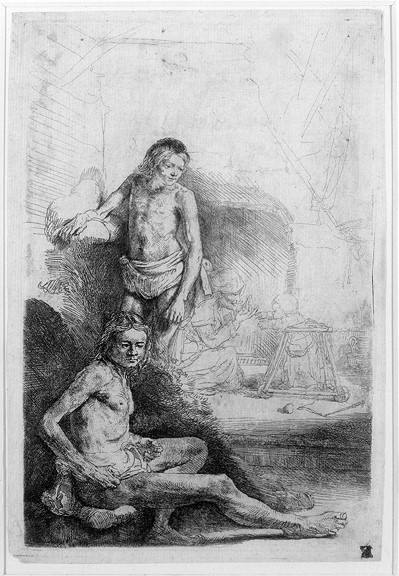
“Male Nude, seated and standing ( Het Rolwagentje)”, circa 1646
Etching: 194 x 128 mm
watermark: possibly small cup.
"*" indicates required fields
Notes
In the foreground we see two studies of the same young man: standing and sitting. In the background of a typical Dutch kitchen with an open fireplace, very lightly etched, we see a woman teaching a child to walk with the aid of a baby walker.
This print can be seen as a metaphorical exhortation to ‘keep trying’: the child must learn to walk and the artist must practise constantly to master his art.
It is very rare to have two independent different subjects, except in study-sheets. In 1646, Rembrandt executed three studies of young males only wearing a loin cloth (White-Boon 193/194/196).
It could well be that the part with woman and child were in fact Geertje Dircks and his than 1,5 years old son Titus at home, etched as early as 1643. A few years later the study of two young boys could have been added onto this very plate.
Provenance
- H. Danby Seymour 1820-1877 (Lugt 176)
- John Barnard died 1784 (Lugt 1419)
- George Hibbert 1757-1837 (Lugt 2849)
- Paquale Iannetti, San Fransisco, 2006
- Private collection, USA
- Douwes Fine Art, Amsterdam
Literature
Bartsch 194; Hind 222;
‘The New Hollstein, 2013, no. 233, fifth state (of VIII) , possibly by Claude-Henri Watelet, before the horizontals added to the lower part of the mount above the lower part of his outstretched leg; with vertical lines added to the blank patch on the seated model’s right shoulder.
Plate in existence – with Nowell-Usticke (1967): C1
Condition
A well balanced and delicate early 18th century impression, complete with good margins